
Key takeaways
- Gravity sets the rule: allergen-free goes above, allergens below — crumbs and powders fall down, never up, so the height order of your shelves is the cheapest risk reduction you have.
- Sealed rigid containers are barriers; bags and clips are not — an airtight rigid container contains spills and dust in a way a folded-over bag cannot, per the same logic manufacturers use for freshness.
- Dedicated scoops beat shared ones, every time — a scoop that touches flour and then a nut-free product is a direct cross-contact path, and color-coding removes the guesswork.
- Labels have to survive the dishwasher or they're theater — a label that peels off in a wash cycle leaves an unmarked container, which is worse than no system at all.
- This reduces likelihood; it does not guarantee safety — organization lowers the odds of cross-contact, but a diagnosed allergy is managed with a clinician, not a pantry layout.
What's in this guide
- The short verdict
- Read this first: what this guide is and isn't
- The physics of crumb fall: why height order comes first
- Sealed rigid containers as barriers
- Dedicated utensils, scoops, and the shared-hand problem
- Labels that survive the dishwasher
- Separate prep-surface thinking
- A zone map you can copy
- Side-by-side comparison
- What to look at
- Common questions
The short verdict
This is organizational guidance, not medical advice. If someone in your home has a diagnosed food allergy, your clinician's or allergist's instructions come first, always, and nothing here replaces them. Within that boundary, a well-organized pantry can meaningfully reduce the likelihood of cross-contact — the accidental transfer of an allergen — by putting allergen-free foods above everything else, sealing allergens in rigid barriers, and giving them dedicated scoops and labels. No storage system prevents an allergic reaction, and this guide never claims to; it describes lowering risk, not eliminating it.
Read this first: what this guide is and isn't
This is a guide to organizing a pantry to reduce the likelihood of cross-contact — the unintended transfer of a food allergen from one item, surface, or utensil to another. It is organizational guidance only. It is not medical advice, and it cannot tell you what is safe for a specific person.
If anyone in your household has a diagnosed food allergy, the direction of your physician or allergist takes priority over anything written here. They know the individual's threshold, history, and emergency plan; a storage article does not. Please treat this piece as a way to support a plan your clinician has already given you, never as a substitute for one. If you don't yet have that medical guidance, getting it is the first and most important step — before you reorganize a single shelf.
We also want to be plain about a limit that matters: no pantry system prevents an allergic reaction. Organization can lower the odds that an allergen ends up somewhere it shouldn't. It cannot eliminate risk, and this guide will never say that it does. You'll notice we consistently write 'reduce the likelihood of cross-contact' rather than 'prevent' or 'make safe' — that wording is deliberate and accurate. For the regulatory backdrop on which foods must be disclosed on packaging, the U.S. Food and Drug Administration (FDA) publishes food allergen labeling requirements, and patient-facing organizations such as FARE (Food Allergy Research & Education) publish living-with-allergy guidance; both are useful, and neither replaces your own clinician.
The physics of crumb fall: why height order comes first
The single most effective organizing decision in a shared pantry costs nothing: put the allergen-free foods above the allergen-containing ones, never below. The reason is gravity. Crumbs, flour dust, a trickle of spilled cereal, a shaken-loose fragment of nut — all of it falls down. None of it falls up. So whatever sits on the lower shelves is exposed to fallout from above, while whatever sits on top is protected from everything beneath it simply by being out of the fall path.
This is why height order beats almost every other single measure. If a bag of flour on a high shelf develops a leak, it can dust every shelf below it. Flip the arrangement — flour low, the nut-free or gluten-free foods high — and a leak up top is no longer raining allergens onto the safe foods, because there aren't any allergens up top. The safe zone is defended by position, not by hoping nothing ever spills.
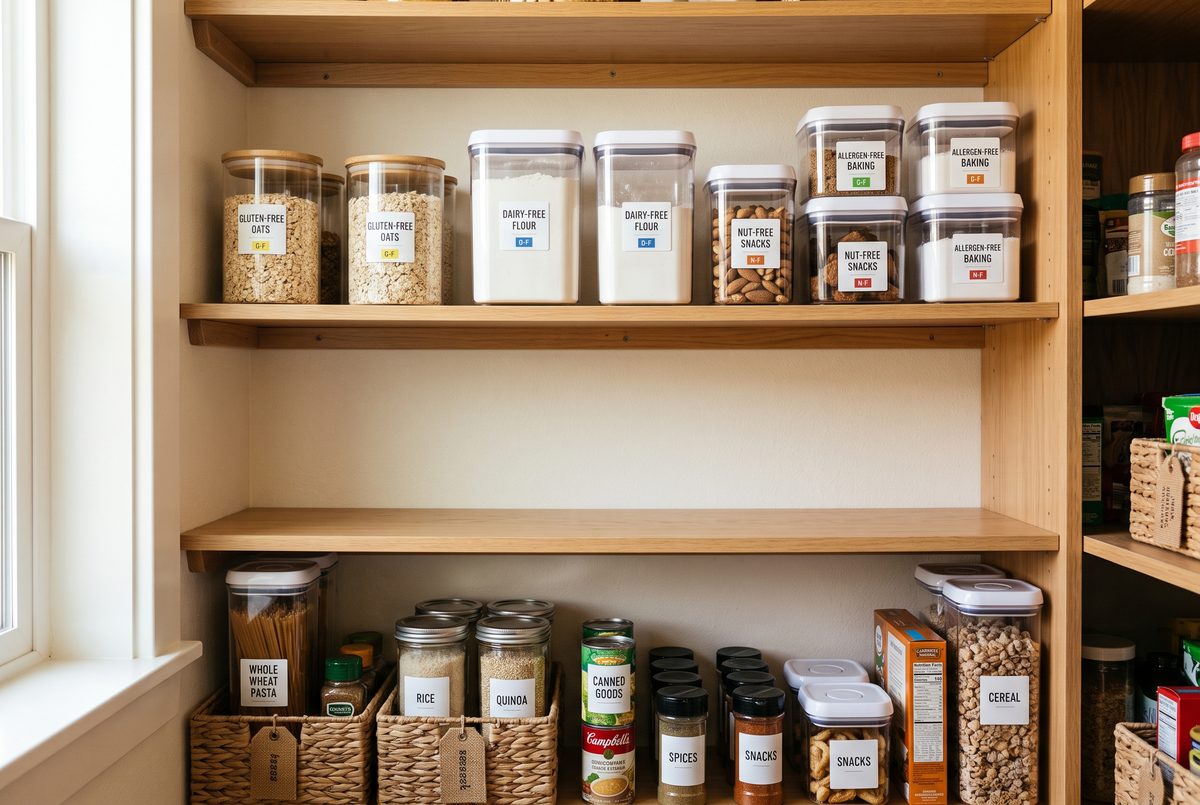
The practical rule set follows directly: assign the top shelves to allergen-free items, the middle shelves to everyday shared items, and the bottom shelves to the messiest allergens — flours, nut products, anything powdery or crumb-prone. Keep a gap in the mental model too: the highest allergen-free shelf should not sit directly beneath an allergen container that could weep or spill onto it. This is reasoning from basic physics — things fall down — and it's the backbone of the zone map later in this guide. It reduces the likelihood of cross-contact; like everything here, it does not guarantee against it.
Sealed rigid containers as barriers
Once the height order is set, the next layer is containment: putting allergens inside something that actually stops them from escaping. A folded-over bag held with a clip is not that something. It leaks dust from the top, it can tip and spill, and a punctured corner sheds its contents onto whatever is nearby. An airtight rigid container is a genuine barrier — it keeps powders and crumbs inside a hard shell that won't tip open or dust its surroundings.
The logic is the same one manufacturers rely on for freshness: a sealed rigid wall contains what's inside far better than flexible film. Here we're borrowing that containment for a different purpose — keeping an allergen from migrating to a safe food. Prioritize rigid containers for the messiest, most mobile allergens first: flours, ground nuts, crumb-heavy items. These are the ones whose fine particles travel, and the ones a barrier helps with most.
A few practical notes that follow from how barriers work rather than from any test we ran. A container only contains if it's actually closed, so a lid that seals positively (a latch or a gasket) does more than one that rests loosely on top. Overfilling defeats the seal, so leave headroom. And containment is directional in the same way height is: even a well-sealed allergen container belongs on a lower shelf, because the barrier is your second line of defense, not a license to ignore the first. Rigid, sealed, and low is the pattern. It reduces the likelihood that an allergen escapes toward a safe food; it does not make the pantry safe in any absolute sense, and we won't claim it does.
Dedicated utensils, scoops, and the shared-hand problem
A surprising amount of cross-contact happens not through spills but through tools. A single measuring cup that scoops wheat flour and then, unwashed, scoops a gluten-free flour has just carried the allergen directly into the safe product — no leak required, no shelf involved. The scoop is the vector. This is one of the most common and most preventable cross-contact paths in a home kitchen.
The fix is dedication: give each allergen-free product its own scoop or measuring tool that never touches anything else, and keep that tool with that container rather than in a shared drawer where it can brush against contaminated utensils. Color-coding makes this durable in a way memory doesn't — assign a color to 'allergen-free only' tools so that anyone in the household, including a guest or a tired cook at the end of a long day, can see at a glance which scoop belongs where. A system that depends on remembering will eventually fail; a system you can see holds up.
The same thinking extends to hands and to the sequence of tasks. Reaching into a bag of nuts and then into a nut-free container transfers residue just as a shared scoop does, which is why washing hands between handling an allergen and handling a safe food is part of the same principle. Store the dedicated scoop inside or clipped to its container so the right tool is always the nearest tool. None of this is medical guidance — it's organizational practice aimed at reducing the likelihood of cross-contact, and it works by removing the shared pathways that let an allergen travel from one food to another.
Labels that survive the dishwasher
A labeling system is only as good as its worst-surviving label. The failure mode is specific and common: you decant flour into a clear container, write a nice label, run the container through the dishwasher weeks later, and the label peels off in the heat and spray. Now you have an unmarked container that looks identical to the safe one beside it — and an unmarked allergen container is arguably more dangerous than an obviously bagged one, because it invites a confident mistake.
So durability isn't a nicety here; it's the point. Labels intended for a pantry that sees washing need to be built for it: printed with waterproof or oil-resistant material and adhesive rated to hold through repeated dishwasher cycles, or applied to a part of the container that doesn't go through the wash. Handwriting on masking tape is fine for a week and a liability for a year. The label has to outlast the container's cleaning routine, or the system quietly degrades into unlabeled guesswork.
Content matters alongside durability. A useful allergen label states plainly what the container holds and, where relevant, flags it as an allergen so the message survives a glance rather than requiring a read. Consistency helps too — the same label style and placement across the pantry means the eye learns where to look. And tie this back to the FDA point from earlier: packaged foods are required to disclose major allergens on their original labels, so when you decant a product out of its packaging, you're taking on the job that label was doing. Reproducing that information durably is how you keep it. This is organizational practice for reducing cross-contact likelihood, not a safety guarantee.
Separate prep-surface thinking
The pantry doesn't end at the shelf — it hands off to the counter, and cross-contact follows the food out. A cutting board or countertop that just held an allergen can transfer residue to the next food prepared on it, which means prep-surface planning is part of the same system as shelf order and sealed containers, not a separate concern. Thinking of them together is what closes the loop.
The organizational moves mirror the pantry ones. Dedicating a specific board or a specific prep zone to allergen-free work, and marking it the same way you color-code scoops, gives you a surface you can trust for the safe foods. Sequence helps when a fully separate surface isn't practical: preparing the allergen-free food first, on a clean surface, before the allergens come out, reduces the chance that residue is already present. Thorough cleaning between tasks matters, and porous or deeply scored surfaces are harder to clean fully than smooth ones — a scratched wooden board can hold residue in its grooves in a way a smooth, cleanable surface doesn't.
Storage supports this: keeping the dedicated allergen-free board stored away from the general boards, ideally near the allergen-free shelf, keeps the whole safe workflow physically grouped. The through-line across this entire guide is that cross-contact travels along pathways — shelves, spills, scoops, hands, surfaces — and reducing its likelihood means closing those pathways one at a time. We're reasoning from how residue transfers, not reporting a test, and we'll say it once more because it matters: this lowers risk, it does not eliminate it, and a diagnosed allergy is managed with your clinician.
A zone map you can copy
Here is the whole system expressed as a shelf-by-shelf map, so you can apply it without re-deriving it. Read it top to bottom, because the order is the point.
Top shelf — allergen-free only. Reserve the highest shelf for the foods that must stay clean: the nut-free, gluten-free, or otherwise allergen-free items. Nothing above them can fall onto them. Store their dedicated, color-coded scoops right here with them.
Upper-middle — allergen-free overflow and low-risk staples. Extra safe items and dry goods that aren't allergens, still comfortably above the messy zone.
Lower-middle — everyday shared items. Cans, jars, and sealed goods that aren't major allergens and aren't prone to dusting. This is the neutral buffer between the safe zone above and the allergen zone below.
Bottom shelf — allergens, sealed and rigid. Flours, nut products, and anything powdery or crumb-prone, each in an airtight rigid container with a dishwasher-durable label, placed where a spill or leak falls onto the floor of the pantry, not onto food. Keep allergen scoops and the dedicated allergen prep board grouped down here.
The map encodes every principle in this guide: gravity (safe on top), barriers (rigid and sealed at the bottom), dedicated tools (grouped with their zone), and durable labels (throughout). Adapt the number of shelves to your space, but keep the direction — allergen-free always above allergens. This is an organizational template for reducing the likelihood of cross-contact. It is not medical advice, it does not prevent reactions, and it does not replace the guidance of the allergy sufferer's clinician, which comes first in every case.
Side-by-side comparison
| Zone | What goes here | Why | Container and tools |
|---|---|---|---|
| Top shelf | Allergen-free items only | Nothing falls upward onto them | Airtight rigid; dedicated color-coded scoops kept here |
| Upper-middle | Safe overflow, non-allergen staples | Still above the messy zone | Sealed containers; durable labels |
| Lower-middle | Everyday shared, non-dusting goods | Neutral buffer layer | Cans and jars; standard labels |
| Bottom shelf | Flours, nuts, powdery allergens | Spills fall to floor, not onto food | Airtight rigid, latched; dishwasher-durable labels; allergen scoops grouped here |
What to look at
Check current specifications and reviews yourself before buying — product lines change.
Use airtight rigid containers with a positive-sealing lid
A rigid shell with a lid that seals positively contains fine powders and crumbs in a way a folded bag cannot, following the same containment logic manufacturers use for freshness. Leave headroom so the seal actually closes, and keep these on the lower shelves. This reduces the likelihood an allergen escapes toward safe food; it is not a safety guarantee.
Retail links added after affiliate approvalNo purchase link is active. Compare current specifications and retailers independently.
Choose waterproof, dishwasher-durable labels
A label that survives cleaning is what keeps an allergen container from becoming an unmarked one, which is the worse outcome. When you decant a food out of its original FDA-mandated allergen labeling, a durable label reproduces the information that packaging was carrying. Organizational practice, not medical advice.
Retail links added after affiliate approvalNo purchase link is active. Compare current specifications and retailers independently.
Assign color-coded dedicated scoops per allergen-free product
A shared scoop is a direct cross-contact path — it carries residue straight into the next food regardless of shelf order. Color-coding makes the system visible so it holds up when memory doesn't, for guests and tired cooks alike. This lowers the likelihood of cross-contact; it does not eliminate risk, and your clinician's plan comes first.
Retail links added after affiliate approvalNo purchase link is active. Compare current specifications and retailers independently.
Common questions
Have you tested these yourself?
No. The Lit Shelf does not own or operate these products, and nothing here is a hands-on review or a laboratory result. This guide is built from the physics of how crumbs and residue transfer, from published regulatory context such as the FDA's food allergen labeling requirements, and from the existence of living-with-allergy guidance from organizations like FARE.
Where a recommendation is our own reasoning — the height order, the containment logic, the tool and surface practices — we say so in the text. Most importantly, none of it is medical advice, and it does not replace an allergist's or physician's direction for a diagnosed allergy.
Will an organized pantry prevent an allergic reaction?
No, and we won't claim otherwise. Good organization can reduce the likelihood of cross-contact — the accidental transfer of an allergen — by closing the pathways it travels: shelf order, spills, shared scoops, hands, and prep surfaces. That is a real, worthwhile risk reduction.
But reducing likelihood is not the same as preventing a reaction, and no storage system can guarantee safety. A diagnosed food allergy is managed medically, with an allergist or physician, including an emergency plan. Please treat this guide as support for that plan, never as a replacement for it.
Why does allergen-free food go on the top shelf?
Because things fall down, not up. Crumbs, flour dust, and spilled fragments drop onto whatever sits below them, so anything on a lower shelf is exposed to fallout from above. Putting the allergen-free foods on top keeps them out of that fall path.
Flip it and the risk rises: allergens up high can dust every safe food beneath them if a bag leaks or a container tips. Height order is the cheapest single measure you have for reducing cross-contact likelihood, which is why this guide treats it as the foundation.
How do I label containers so the system doesn't fall apart?
Use labels built to survive your cleaning routine — waterproof or oil-resistant material with adhesive rated for repeated dishwasher cycles, or placed where the container isn't washed. A label that peels off leaves an unmarked container, which invites a confident mistake and is worse than an obviously bagged product.
State the contents plainly and flag allergens so the message reads at a glance. Remember that decanting a food out of its packaging removes the allergen information the FDA requires on that packaging, so your durable label is now doing that job.
Evidence & limitations
Sources used for this guide
- FDA: Food Allergies — Major-allergen labeling and cross-contact context. Organization can reduce risk; it cannot guarantee safety.
How to read this: Manufacturer pages support product specifications; institutional sources support the cited guidance. Our comparisons and recommendations are editorial analysis, not laboratory testing.
Measure before you shop
Use the free printable shelf checklist—no email required.