Key takeaways
- Conditions matter more than the material label. Published concern about plastics concentrates on heat, fat, and acid; the FDA notes migration from packaging rises with temperature and contact time, so the same plastic can be low-concern for flour and higher-concern for reheated tomato sauce.
- "BPA-free" answers one narrow question, not the whole one. It means that specific compound was not used; the FDA still considers approved food-contact plastics acceptable, and "BPA-free" says nothing about the other substances a given plastic may contain.
- Microplastics are an active research area, not a settled verdict. The WHO has said current evidence does not indicate a clear health risk at observed levels while calling for more study — so we describe an open question rather than assert a danger.
- Glass has its own real failure mode: thermal shock. Soda-lime glass tolerates sudden temperature swings far less well than borosilicate, which is the physics behind the "exploding glass dish" complaint cluster; the fix is technique and knowing which glass you own.
- We have not tested these products. This piece summarizes FDA, USDA, and WHO guidance plus published material properties and documented owner complaints; it is not medical advice, and your clinician's guidance comes first.
What's in this guide
- The short verdict
- The question is wrong until you add conditions
- What "BPA-free" actually means — and doesn't
- Microplastics: an open research question, stated honestly
- Glass's own hazard: thermal shock and the "exploding dish" cluster
- The unglamorous tradeoffs: weight, breakage, and recycling
- A decision framework, not a winner
- Side-by-side comparison
- What to look at
- Common questions
The short verdict
For hot, fatty, or acidic food, glass is the more cautious default because the conditions that concern researchers about plastics — heat and prolonged fat or acid contact — mostly do not apply to glass. For dry goods at room temperature, the practical safety gap is small, and weight and breakage become the deciding factors instead. There is no universal winner: choose by what the container will actually hold and how it will be used, and take any specific health question to your own clinician.
The question is wrong until you add conditions
"Is glass safer than plastic?" cannot be answered as asked, because the honest answer depends entirely on what the container holds and what you do to it. The same plastic tub can be a non-issue for dry rice and a reasonable thing to avoid for reheating oily leftovers, and that is not a contradiction — it is the whole point.
The reason is chemistry plus physics. Any migration of substances from a plastic into food is driven by three things: temperature, fat content, and acidity, all increasing with contact time. The US Food and Drug Administration, which reviews food-contact materials before they may be sold, describes migration as rising with higher temperatures and longer contact. Heat gives molecules energy to move; fat and acid are better solvents for many of the compounds involved than plain dry starch is.
So the useful way to think about it is a gradient, not a binary. At one end: dry, room-temperature, low-fat contents in a sealed container — flour, sugar, rice, pasta. Here the practical difference between glass and food-grade plastic is small. At the other end: hot, greasy, or acidic food, especially reheated in the container. Here the cautious choice leans toward glass, because glass does not participate in that chemistry.
Everything below fills in that gradient. We are summarizing institutional guidance and material properties, not making a medical claim; a specific health concern belongs with your own clinician, who knows your situation.
What "BPA-free" actually means — and doesn't
Bisphenol A (BPA) is a compound historically used in some polycarbonate plastics and can linings. Public concern led manufacturers to label products "BPA-free," and that label now carries an aura of general safety it does not strictly earn.
What "BPA-free" tells you: this specific compound was not used in this product. That is a real, verifiable statement, and if avoiding BPA is your goal, the label is relevant.
What it does not tell you: whether the substitute compounds are better, worse, or simply less studied, and whether anything else in the plastic could migrate under heat or fat. "BPA-free" is silent on all of that. It is one answered question, not a clean bill of health.
It is also worth stating plainly what the regulator says. The FDA's current position is that BPA is safe at the very low levels that occur in some foods from approved food-contact uses, a conclusion it says is based on its ongoing review of the science. So the mainstream regulatory view is not that BPA-containing food-contact plastic is dangerous; it is that approved uses are acceptable. People who nonetheless prefer to minimize exposure choose "BPA-free" or glass, and that is a reasonable personal preference rather than a correction of the FDA.
We are reporting what the manufacturer label claims and what the FDA states, and attributing each; we are not independently certifying any product as safe.
Microplastics: an open research question, stated honestly
No topic in this debate is more heated or less settled than microplastics — tiny fragments now detected widely in the environment, in food and water, and in human tissue samples.
Here is the careful version. It is established that microplastics are widespread and that people ingest them. What is not established is a specific, quantified health harm at the levels people are actually exposed to. The World Health Organization, reviewing microplastics in drinking water, concluded that the available evidence did not indicate a clear health risk at current levels while explicitly stressing that the data are limited and that more research is needed. That is a call for study, not an all-clear and not an alarm.
So the intellectually honest framing is: this is an active area of research where the exposure is real and the health significance is genuinely uncertain. Anyone who tells you microplastics from your food container are definitely harming you, or definitely harmless, is claiming more than the current evidence supports.
What that means practically is modest. If you want to reduce plastic contact on precautionary grounds — a legitimate choice while the science develops — favouring glass for hot and fatty foods is the highest-yield place to do it, since heat and fat are where migration concentrates. For dry, cool storage the exposure pathway is far weaker. We are describing the state of the evidence and citing the WHO; we are not making a medical claim, and a personal risk question belongs with your clinician.
Glass's own hazard: thermal shock and the "exploding dish" cluster
Glass sidesteps the migration debate, but it has a failure mode plastic does not: it can break, and under thermal shock it can break suddenly and forcefully. This is the complaint cluster behind viral "my glass dish exploded" stories, and the physics is worth understanding because it changes how you use the thing.
Thermal shock happens when part of a glass item changes temperature much faster than the rest. The hot part expands, the cold part does not, and the resulting stress can exceed what the glass can hold — so it fractures, sometimes energetically. The trigger is a steep, sudden temperature gradient: a hot dish onto a cold or wet stone counter, a frozen dish into a hot oven, boiling water into a chilled glass.
Material matters a great deal here. Borosilicate glass has a low coefficient of thermal expansion and tolerates sudden swings comparatively well. Soda-lime glass — cheaper and common in modern consumer bakeware — expands more and is more prone to thermal-shock failure. A widely discussed point among owners is that some bakeware lines historically made from borosilicate were later produced in tempered soda-lime, which behaves differently; tempering improves strength but does not make soda-lime equal to borosilicate on thermal shock. Manufacturers state the glass type and the safe temperature limits, and those statements are the authority to follow for your specific dish.
The practical rules that follow from the physics: do not move glass straight from freezer to hot oven or vice versa, do not set a hot dish on a cold wet surface, and respect the manufacturer's stated maximum temperature and any "no broiler" or "no stovetop" warning. We are reasoning from material properties and pointing you to the manufacturer's own limits, not testing a specific dish to failure.
The unglamorous tradeoffs: weight, breakage, and recycling
Once safety is put in its proper conditional place, the day-to-day decision is often made by dull practical factors, and it is worth being honest about them.
Weight. A full glass container is markedly heavier than the same volume in plastic. On a high shelf or for a child, an older person, or anyone with grip or wrist limitations, that weight is a real handling hazard — the moment a heavy glass dish slips over a hard floor is exactly when thermal-shock physics stops mattering and simple breakage takes over. Plastic wins cleanly on weight.
Breakage and longevity. Glass chips and shatters; plastic scratches, stains, warps, and can retain odours and grease films over time. Glass tends to last longer if it survives, but "if it survives" is doing work in that sentence in a busy kitchen with tile floors.
Recycling numbers. The resin identification code stamped on plastic (the number in the triangle) identifies the plastic type; it is not by itself a promise that your local program accepts it. Glass is widely recyclable in principle, though acceptance and colour rules vary by locality. Neither material lets you skip checking your own municipal program, and we would rather say that than imply a clean environmental winner.
None of this points to a single answer, which is the honest outcome. It points to matching the container to the job — and that framework is the next section.
A decision framework, not a winner
The right output of this debate is not "buy glass" or "buy plastic." It is a small set of rules you can apply to each container decision.
Lean glass when: the contents are hot, oily, or acidic; you reheat in the container; you want to minimize plastic contact on precautionary grounds; or you value seeing contents clearly and do not mind the weight. Glass takes the migration question off the table for exactly the conditions where that question is strongest.
Lean plastic when: the container lives on a high shelf or will be handled by someone for whom weight and breakage are the bigger risk; it travels in a bag or lunchbox; or it holds dry, cool staples where the safety difference is small and durability plus light weight matter more.
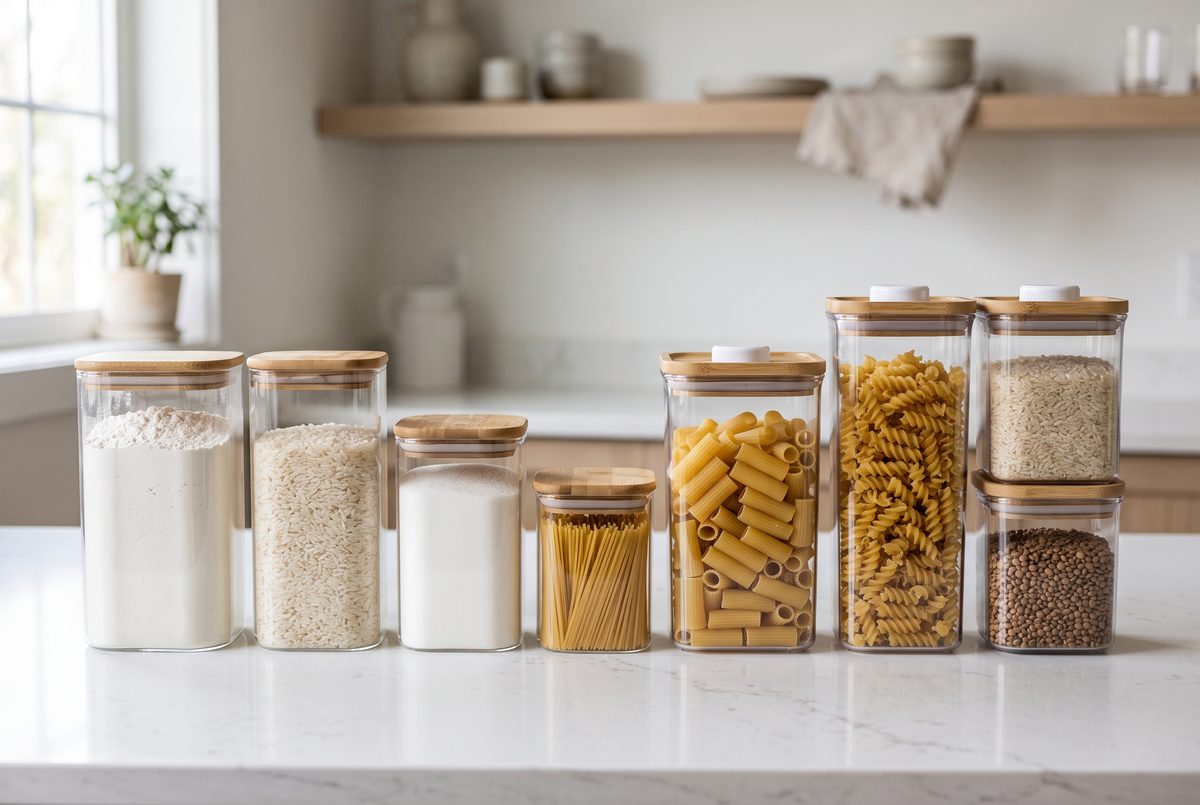
For the specific case this site cares about most — flour, sugar, and rice in a sealed jar at room temperature — the safety argument is genuinely faint. At room temperature, with dry low-fat contents and no reheating, the migration drivers are all near their minimum. Here the choice should be made on the things that actually differ day to day: airtightness against pantry pests and humidity, whether the jar survives a drop, weight on the shelf, and whether you can read the label. Be honest with yourself that the internet's heat on this question is calibrated to the hot-fatty-acidic case, not to your flour.
And the standing caveat: this is a summary of FDA, USDA, and WHO guidance and of material physics, not medical advice. If you have a specific health reason to avoid a material, your clinician's guidance comes first, every time.
Side-by-side comparison
| Condition or factor | Glass | Plastic (food-grade) | What the sources say |
|---|---|---|---|
| Hot / fatty / acidic food | Cautious default; inert to the food | Migration drivers highest here | FDA: migration rises with heat and contact time |
| Dry goods at room temp | Fine; safety edge is small | Fine; safety edge is small | Practical difference is minor in this case |
| Sudden temperature change | Thermal-shock risk; borosilicate tolerates it better than soda-lime | Not applicable in the same way | Follow the manufacturer's stated temperature limits |
| Weight and breakage | Heavy; can shatter | Light; scratches and stains | Owner complaints cluster on glass weight and breakage |
| Microplastic exposure | Not a plastic source | An area of ongoing research | WHO: evidence does not show a clear risk at current levels; more study needed |
What to look at
Check current specifications and reviews yourself before buying — product lines change.
Favour glass, and read the stated temperature limits
For hot, fatty, or acidic contents, glass takes the migration question off the table under exactly the conditions the FDA associates with higher migration. Because thermal shock is glass's real weakness, treat the manufacturer's stated glass type and temperature limits as the authority and never move a dish straight between freezer and hot oven. We reason this from material properties, not from testing a specific dish.
Retail links added after affiliate approvalNo purchase link is active. Compare current specifications and retailers independently.
Choose food-grade plastic and weigh handling risk over theory
For dry or cool contents that get carried, dropped, or lifted overhead, plastic's light weight and shatter resistance address the risk you are actually most likely to face. The manufacturer states whether a product is intended for food contact, and the resin code tells you the plastic type; confirm your municipal program accepts that number rather than assuming the triangle means recyclable. This is us reporting labels and guidance, not certifying safety.
Retail links added after affiliate approvalNo purchase link is active. Compare current specifications and retailers independently.
Decide on airtightness and drop-survival, not the safety debate
For flour, sugar, and rice in a sealed jar, the safety gap between glass and plastic is small, so the sensible deciding factors are the seal against pests and humidity and whether the container survives being knocked off a shelf. University extension services recommend airtight rigid containers specifically to keep pantry pests out; that practical benefit outweighs the material debate for dry storage. Choose whichever material you will keep sealed and full.
Retail links added after affiliate approvalNo purchase link is active. Compare current specifications and retailers independently.
Common questions
So which one should I just buy?
There is no single correct material, and any page that gives you one is oversimplifying. Match the container to the job: glass for hot, oily, or acidic food and for reheating; plastic for high shelves, lunchboxes, and anywhere weight or breakage is the bigger practical risk.
For dry pantry staples at room temperature, buy on airtightness, drop-survival, weight, and label visibility, because the safety difference in that specific case is small. If your kitchen is mixed — most are — owning some of each is a perfectly rational answer, not a failure to decide.
Is it dangerous to microwave food in plastic?
The cautious, evidence-aligned answer is to use only containers the manufacturer marks as microwave-safe, and to prefer glass or ceramic for reheating oily or acidic food. Heat is the condition the FDA associates with increased migration from packaging, and fat and acid make it more pronounced, so reheating is exactly where the theoretical concern is strongest.
This is not us declaring a specific product harmful. It is aligning with the direction of institutional guidance. If you have a particular health concern, your clinician's advice comes first.
Does "BPA-free" mean a plastic is completely safe?
No. It means only that bisphenol A was not used in that product. It says nothing about the substitute compounds or anything else that might migrate under heat or fat, and it is not a general safety guarantee.
Separately, the FDA states that BPA is safe at the low levels that occur from approved food-contact uses, so "BPA-free" is best understood as a personal-preference choice for those who want to minimize exposure, rather than a fix for a confirmed danger. We are reporting the label's meaning and the regulator's position, not certifying any product.
Have you tested these yourself?
No. We have not run laboratory migration tests or lived with these containers, and we will not claim to have.
This explainer summarizes publicly available guidance from the FDA, USDA, and WHO, established material properties such as the thermal-expansion difference between borosilicate and soda-lime glass, and documented patterns in owner complaints about weight and breakage. Every safety-adjacent statement is attributed to its source. It is not medical advice, and where the science is unsettled — microplastics especially — we say so rather than pick a side.
Evidence & limitations
Sources used for this guide
- FDA: Food-contact materials — How FDA regulates substances used in food packaging and food-contact materials.
- FDA: BPA in food-contact applications — FDA's current position on approved BPA uses; cited as the agency's position, not as an independent safety guarantee.
How to read this: Manufacturer pages support product specifications; institutional sources support the cited guidance. Our comparisons and recommendations are editorial analysis, not laboratory testing.
Measure before you shop
Use the free printable shelf checklist—no email required.