
Key takeaways
- The lid avalanche is an inventory problem, not a storage problem. It comes from years of mismatched sets accumulating, so no organizer fixes it until you cut the collection down to what actually pairs.
- The audit is the whole game: pair every lid to a base and discard the orphans. A lid with no base and a base with no lid are both taking space to do nothing.
- Choose one system going forward, ideally one that nests and shares lids. Mixed brands are why nothing stacks; a single family stacks predictably and cuts the number of distinct lids you store.
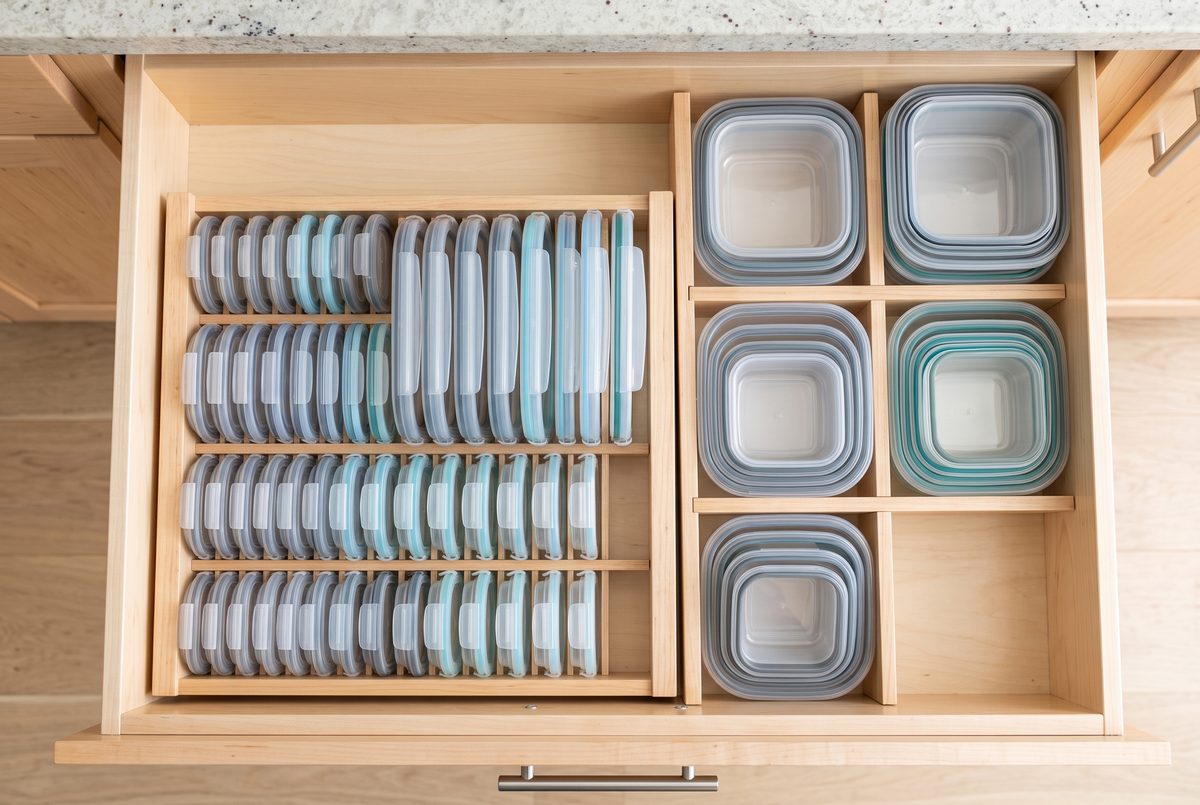
- Store lids on their edge, not in a flat stack. Vertical filing — a rack, a drawer divider, or a repurposed file organizer — makes every lid visible and stops the topple, which is what actually keeps the system alive.
- We have not tested these products. The method is drawn from the geometry of nesting and stacking, documented owner complaints, and standard organizing practice; where we reason rather than cite, we say so.
What's in this guide
The short verdict
The honest fix is owning fewer, matched containers, so the best first move costs nothing: audit hard and discard every orphan. If you cook often and reuse containers constantly, standardizing on one system pays off, and vertical lid storage keeps it that way. Skip buying new organizers entirely if your set is already matched and the cabinet is just untidy — that is a ten-minute reset, not a purchase.
Why the lid avalanche happens
Open the cabinet, reach for a container, and three lids slide out onto the floor. Everyone knows the scene. It is worth being precise about the cause, because the cause tells you the cure.
The avalanche is not because you lack a lid organizer. It is because, over years, you have accumulated containers from different sources — a set bought here, takeaway tubs kept there, a hand-me-down stack, replacements for lids that cracked — and almost none of them share a lid. Every distinct base needs its own distinct lid, so the number of loose, non-interchangeable lids grows without bound. Those lids are flat, light, and curved, so stacked flat they slide; stood loose they fan out and fall. The physical chaos is just the visible symptom of an inventory that has too many incompatible parts.
This reframing matters because it explains why buying an organizer so often fails. An organizer imposes order on the number of items you already own. If that number is bloated with orphans and one-offs, you have simply bought a nicer container for the chaos. The lid rack fills up with lids that fit nothing you reach for, and within a month the avalanche is back.
So the sequence has to be: fix the inventory first, then store what remains. We call the method the One-System Reset — audit down to what pairs, commit to a single family going forward, and store lids vertically. The rest of this guide is those three steps, and the honest headline is that the first step often means owning less, not buying more.
Step one: the ruthless audit
This is the step people skip and the step that actually works. Set aside twenty minutes and empty the entire cabinet onto a table — every base, every lid, no exceptions. You cannot audit what you cannot see, and a half-emptied cabinet just relocates the problem.
Now pair. Snap or seat every lid onto a base. Work in one direction so you do not double-handle. As you go, three piles form: matched sets (a base with its lid), orphan lids (no base survives), and orphan bases (no lid survives). The orphans are the whole reason the cabinet overflows, and both kinds are pure dead weight — an orphan base cannot seal and an orphan lid fits nothing you own.
Be ruthless with the orphans. A lid whose base cracked or warped is not "maybe useful someday"; it is a flat plastic disc taking a slot. A base whose lid vanished is a tub you will reach for, find lidless, and put back annoyed. Recycle or discard them according to your local program's rules for that plastic. If parting with them is hard, box the orphans, date the box, and put it out of the kitchen; if you have not gone looking for anything in it within a couple of months, that is your answer.
While pairing, note honestly which sizes you actually reach for. Almost everyone finds they use a few mid-size containers constantly and own far too many of the very large and very tiny ones. That count is your real inventory, and it tells you what — if anything — you need to add later. We are reasoning from ordinary use patterns here, not from a study of your kitchen specifically.
Step two: commit to one system going forward
With the survivors in front of you, the decision is what to standardize on — because the root cause was mismatch, and the cure is a single compatible family.
The property that matters most is shared, interchangeable lids. A system where one lid size fits several base sizes collapses your lid count dramatically: instead of a unique lid per base, you store a handful of lid sizes that cover the whole set. The second property is that the bases nest when empty, so the collection shrinks into itself in the cabinet instead of standing full-height all the time. A set that both shares lids and nests is doing the two things that defeat the avalanche at once.
Material is a secondary choice and depends on use, which we cover in our glass-versus-plastic explainer; for the organizing problem specifically, compatibility beats material. What you are buying, if you buy anything, is standardization — not more capacity.
Crucially, going forward you have to stop the inflow that caused the mess. That means: stop keeping takeaway tubs "just in case," stop adding singleton containers from other systems, and when something breaks, replace it within the family or retire the whole size. One system means one system. The discipline is not glamorous, but it is what prevents you from re-accumulating a drawer of incompatible lids over the next three years.
And the honest note: if your surviving set is already a matched family, the correct amount to buy at this step is nothing.
Step three: store lids vertically, nest the bases
Only now, with a lean matched set, does storage hardware make sense — and the single most effective principle is to store lids on their edge, not in a flat stack.
The physics is simple. Lids stacked flat are a slippery, curved pile with nothing to register against, so any disturbance topples them — the avalanche. Stood vertically on their edges and separated, each lid is held in its own slot, fully visible, and retrievable without disturbing its neighbours. Filing lids like records or documents is the move that most directly kills the daily frustration. A dedicated lid rack does this; so does a set of adjustable drawer dividers; so, cheaply, does a repurposed desktop file organizer or a dish rack. We are reasoning from the geometry of the objects, not endorsing one gadget.
Sort the vertical lid store by size so a glance finds the one you want. Keep the bases separately and nested — largest outermost — so the empty set occupies the least space. The reason to separate lids from bases at rest is that storing every container lidded doubles the height each one needs and wastes the cube; nesting the bases and filing the lids uses the space far better.
Drawer or cabinet is mostly about what you have. A deep drawer suits vertical dividers beautifully and gives a top-down view of both nested bases and filed lids — the easiest layout to keep tidy. A cabinet works with a lid rack plus nested base stacks, though it asks a little more discipline because you are reaching in rather than looking down. Either way, the winning pattern is the same: lids on edge, bases nested, sorted by size.
The maintenance habit that keeps it working
Every organizing system decays without one small recurring habit, and for containers the habit is a thirty-second rule at the point of unloading the dishwasher or drying rack.
The rule: a base and its lid are put away together, and each goes to its home — the base nested with its size, the lid filed on edge in its slot. The failure mode of every container cabinet is the "deal with it later" pile of clean containers dumped in lidded and stacked, which is precisely how the flat, topple-prone stack rebuilds itself. Putting the two parts to their two homes as you unload is the entire maintenance cost.
A second, occasional habit: when a lid cracks or a base warps, retire it immediately rather than returning it to the cabinet. A damaged part re-enters the system as a future orphan the moment its partner fails, so removing it at once keeps the matched-set count honest. If you standardized on one family, replace within that family or drop the size entirely.
Finally, a light quarterly glance is enough to catch drift — a takeaway tub that sneaked in, a lid that lost its base. Pull those the moment you notice them. This is not a second full audit; it is a two-minute weeding.
The reason this works where willpower alone does not is that a lean, matched, vertically-stored set makes the tidy action easier than the untidy one. When every lid has an obvious slot, filing it is faster than tossing it on a pile. Good systems win by making the right move the path of least resistance, and this one does.
Side-by-side comparison
| Step | What you do | The point of it | What to buy |
|---|---|---|---|
| Audit | Empty the cabinet; pair every lid to a base; discard orphans | Fixes the inventory that causes the avalanche | Nothing — this step is free |
| Standardize | Commit to one family with shared lids that nest | Cuts distinct lid count and shrinks the set | One matched system, only if the survivors are not already matched |
| Store | File lids on edge; nest bases by size | Stops the topple and reveals every lid | A lid rack, drawer dividers, or a repurposed file organizer |
| Maintain | Put base and lid to their homes at unload; retire damaged parts | Keeps the lean set from re-bloating | Nothing |
What to look at
Check current specifications and reviews yourself before buying — product lines change.
Standardize on a family with interchangeable lids
The mismatch is the root cause, so a system whose single lid size fits multiple bases collapses the lid count that creates the avalanche. Manufacturers publish which lids fit which bases and whether bases nest; check that before buying, and buy the sizes your audit showed you reach for rather than a big uniform block. We reason this from stacking geometry, not from testing a particular set.
Retail links added after affiliate approvalNo purchase link is active. Compare current specifications and retailers independently.
Add a vertical lid rack or adjustable drawer dividers
Storing lids on edge is the single highest-value change, because a flat stack of curved lids has nothing to stop it sliding. An adjustable rack or divider files each lid in its own slot so it is visible and stays put; size the slots to your largest lid and the footprint to your measured drawer. A repurposed desktop file organizer does the same job — the principle matters more than the product.
Retail links added after affiliate approvalNo purchase link is active. Compare current specifications and retailers independently.
Common questions
Should I really throw away perfectly good orphan lids?
If the base is genuinely gone — cracked, warped, or long lost — then yes, because an orphan lid fits nothing you own and is only taking a slot. Keeping it is keeping the avalanche.
If you cannot face binning them straight away, use the box test: put all orphans in a dated box outside the kitchen. If you have not needed anything from it within a couple of months, recycle the contents per your local program. This gives cautious owners a safety net without letting the orphans clog the working cabinet.
Is it better to store containers with lids on or off?
For the working cabinet, off is almost always better: nest the bases together and file the lids separately on edge. Storing every container lidded roughly doubles the height each one needs and rebuilds the topple-prone stack, wasting the cube.
The one exception is a small "grab and go" subset you use daily, where keeping a few assembled saves a step. For the bulk of the set, nested bases plus filed lids uses space far better and is easier to keep tidy. We reason this from the geometry, not from testing a specific cabinet.
Do I need to buy a whole new matched set to fix this?
Often not. If your audit leaves you with a coherent matched family, the correct purchase is nothing — you just need to store what you kept, on edge and nested, and hold the maintenance habit.
Buy a new system only when the survivors are a genuine jumble of incompatible brands that will never stack or share lids. Even then, buy the sizes your audit showed you actually use, not a large uniform block. The best version of this advice really does involve spending less, not more.
Have you tested these yourself?
No. We have not bought and lived with these racks and container systems, and we will not claim to have.
The method is built from the physical geometry of how curved lids stack and how bases nest, from documented patterns in owner complaints about mismatched sets, and from standard organizing practice. Where a point is our reasoning rather than a citation — the use-pattern observations, for instance — we say so. The most valuable step, the audit, needs no product at all.
Evidence & limitations
Sources used for this guide
- FDA: Food-contact materials — Regulatory context for food-contact materials. The organization method itself is an editorial workflow, not a tested scientific result.
How to read this: Manufacturer pages support product specifications; institutional sources support the cited guidance. Our comparisons and recommendations are editorial analysis, not laboratory testing.
Measure before you shop
Use the free printable shelf checklist—no email required.