
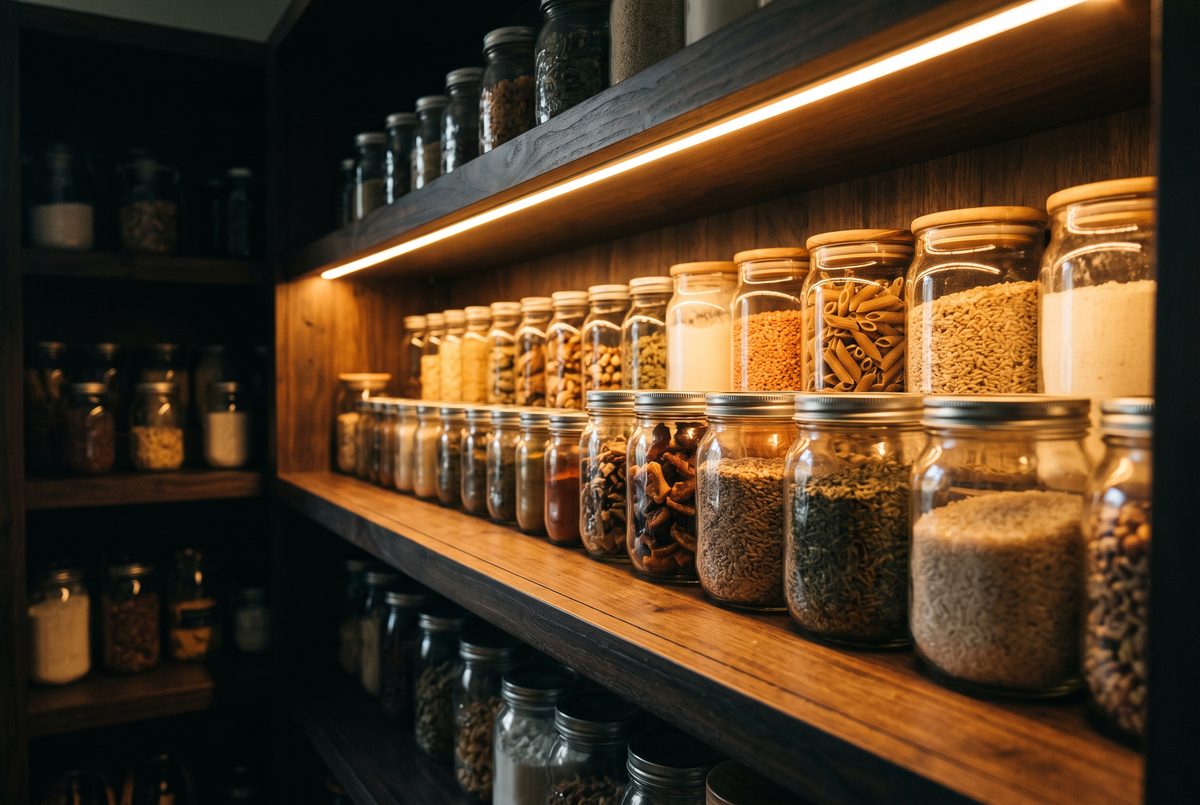
Key takeaways
- Depth can create a visibility problem. On some deeper shelves, organization alone does not make the back easy to see; lighting or a pull-out may help.
- Battery pucks win on installation and lose on brightness. Fine for a cupboard you open twice a day, frustrating on a deep pantry shelf.
- Run strips front to back, not side to side. Lighting the front edge of a deep shelf leaves the back exactly as dark as before.
- Motion sensors suit low-traffic storage only. On a daily-use pantry the delay irritates more than it helps.
- Warm white, not daylight. Cool bulbs make packaging and food look clinical and wrong.
What's in this guide
The short verdict
Choose battery-powered pucks if you rent, cannot run cable, and open the shelf a few times a day. Choose a plug-in LED strip if there is already an outlet inside the cabinet — it is brighter and you will never change a battery. Skip motion sensors on a shelf you open constantly: the activation delay becomes more irritating than the darkness ever was.
Measure the shelf before buying any light
Take one measurement first: how far back does the shelf go?
A standard US wall cabinet runs about twelve inches deep. A pantry cabinet or closet shelf is commonly sixteen to twenty-four. That difference decides everything that follows.
We use roughly sixteen inches as an editorial guidepost, not a tested cutoff. On a shallower shelf, a front light may reach the back adequately. On a deeper shelf, front-mounted light may fall off before it arrives. Shelf spacing, surface color, beam angle, and room lighting can move that boundary substantially, so test the actual shelf.
Why the back of a deep shelf stays dark
Light intensity falls off sharply with distance. Double the distance from a small source and you get roughly a quarter of the illumination.
On a twenty-inch shelf lit from the front edge, the back is receiving a fraction of what the front gets — while your eyes adapt to the bright front, making the back look darker still.
This is why the direction of the light run matters more than the number of lights. A strip mounted along the front edge, running left to right, lights the front beautifully and the back barely at all. The same strip run front to back carries light the full depth.
What actually works in a rental
The constraint that rules out most advice is simple: no drilling, no hard wiring, nothing that leaves a mark.
That leaves battery pucks with adhesive pads, adhesive-backed LED strips with a plug, and plug-in bars that sit on the shelf. All three are genuinely removable.
One caution on adhesive. Strong mounting tape can pull paint or veneer when removed, especially on older cabinets in humid kitchens. Test on an inconspicuous spot, and consider removable mounting strips designed to release cleanly rather than permanent tape.
Colour temperature: the mistake most people make
Buying the brightest, coolest light available is the common error.
High colour temperature — the bluish light sold as daylight — renders food and packaging unpleasantly. Colours read wrong, and the shelf feels like a utility cupboard rather than part of a kitchen.
Warm white in roughly the 2700K to 3000K range keeps food looking like food, matches typical kitchen lighting, and remains perfectly adequate for reading a label. Manufacturers state colour temperature on the packaging; check it before you buy rather than after.
When a motion sensor is the wrong choice
Motion-activated lighting sounds ideal and often is not.
Sensors introduce a short delay between the door opening and the light arriving. On a linen closet you open twice a week, that is invisible. On a pantry you open fifteen times a day while cooking, it becomes a daily irritation — you reach in, wait, then the light arrives.
Reserve sensors for genuinely low-traffic storage. For a working pantry, a simple switch or an always-on strip on the same circuit as the room is less clever and more usable.
Side-by-side comparison
| Factor | Battery puck | Adhesive LED strip | Plug-in bar | Who should care most |
|---|---|---|---|---|
| Install effort | Peel and stick, minutes | Peel and stick, needs a cable run | Needs an outlet inside | Renters and anyone avoiding drilling |
| Brightness | Modest, pooled | Even along the run | Strongest | Deep or tall shelves |
| Ongoing cost | Batteries or recharging | None once installed | None once installed | Frequent users |
| Light spread | Spot pools with dark gaps | Continuous wash | Directional flood | Wide shelves |
| Removable without trace | Yes, usually | Adhesive may mark paint | Yes | Renters worried about deposits |
| Useful starting point | One small area; test coverage | Longer or deeper runs; test orientation | Doors or cabinets where automatic activation helps | Anyone comparing placement before purchase |
What to look at
Check current specifications and reviews yourself before buying — product lines change.
Start with two battery pucks, not six
Two lights placed at the back of the shelf — not the front — tell you your real requirement before you commit to a set. Placing them at the back and letting light spill forward inverts the usual mistake.
Check the stated lumen figure rather than trusting the marketing description, and prefer rechargeable over disposable if you will use the shelf daily.
Retail links added after affiliate approvalNo purchase link is active. Compare current specifications and retailers independently.
A plug-in LED strip, run front to back
Brighter, more even and no batteries to replace. The single decision that matters is orientation: run it front to back along the side wall or underside, not across the front edge.
Measure the depth you need to cover and buy a length that spans it, rather than buying by price and hoping.
Retail links added after affiliate approvalNo purchase link is active. Compare current specifications and retailers independently.
Consider two shorter runs rather than one long one
Very deep shelving benefits from light entering at more than one point. Two shorter runs, or a strip plus a puck at the rear, gives a more even result than one bright source fighting the distance.
Confirm that the strips you choose can be joined or run from a single supply before ordering.
Retail links added after affiliate approvalNo purchase link is active. Compare current specifications and retailers independently.
Common questions
Do LED strips get hot enough to worry about near food?
Modern LED strips run cool compared with older lighting, which is much of their appeal in enclosed spaces. That said, output varies and enclosed cabinets trap heat.
Check the manufacturer's stated operating temperature and any guidance on enclosed installation. We are describing published specifications here, not making a safety assurance.
Will adhesive lights damage my cabinets?
They can. Strong mounting tape sometimes pulls paint or veneer on removal, and older or humid cabinets are more vulnerable.
Test on a hidden area first, and prefer mounting strips designed for clean removal over permanent tape if you rent.
Is it worth lighting a pantry at all, or should I just organize better?
If your shelves are shallow, better organization probably is the answer and you can skip this entirely.
If a deeper shelf remains hard to see after you reorganize it, added light or a pull-out may earn its cost. The approximate sixteen-inch point used in this guide is a hypothesis to test against your shelf, not a universal rule.
Have you tested these products yourself?
No. We have not purchased or lived with these lights, and we will not claim otherwise.
This guide is built from published manufacturer specifications, the physics of light falloff, and patterns in documented owner complaints across retailers. Where we are reasoning rather than citing, the text says so.
Evidence & limitations
Sources used for this guide
- U.S. Department of Energy: LED Basics — Color temperature, color rendering, and LED performance context.
- CPSC: Rechargeable integrated-light recall — A product-specific reminder to check recalls and safety information for rechargeable cabinet lights.
How to read this: Manufacturer pages support product specifications; institutional sources support the cited guidance. Our comparisons and recommendations are editorial analysis, not laboratory testing.
Measure before you shop
Use the free printable shelf checklist—no email required.